I have been thinking about this question a lot lately. I’ve taught for over 20 years in seven different buildings. This includes various grade levels in the elementary setting in the inner city, in military schools, in affluent schools, and somewhere in between. Over the years, I have realized a few things about what it takes to make a school great.
Topics: Administrator Resources, tips for teachers
In our district, we ask teachers to post learning objectives in the room so that the students can see the goal of their learning. The idea is that by posting this, both the teacher and the students will have a focus for the lesson and be able to determine at the end of learning whether they have met the objective for the day.
This clarity of learning is critical for students. It helps the teacher and the students to clarify what they are trying to accomplish. The second layer to this is to add a success criteria to the goal. This is language that shows the student how they will be able to demonstrate they have learned the objective to an appropriate degree. By adding success criteria, we then know how a student can prove learning to the teacher—and more importantly, to themselves.
Topics: tips for teachers
Micro-Cloud Learning Series Part 2: Technology Components of a Micro-Cloud Architecture
In the first part of our micro-cloud learning series, we discussed how this technology is impacting educators and students worldwide. But what exactly does it take to get this technology up and running?
A micro-cloud implementation spans three distinct levels of a distributed architecture. These are the centralized cloud console, the micro-cloud instance(s), and the intelligent devices.
Topics: STEM Lessons, Coding
Micro-Cloud Learning Series Part 1: The Digital Divide in Education
The potential to create a better world through global learning initiatives has never been greater. All of the wisdom and knowledge ever created has been captured, digitized, and catalogued to allow young people to learn and grow faster than ever before. World leaders from both the government and technology sectors have rallied over the last decade to increase learning absorption through e-learning initiatives that put this knowledge at the fingertips of students everywhere in the world.
Topics: STEM Lessons, Coding
Back in September, I was sitting in a district computer teacher meeting discussing activities we used in our classrooms. My colleagues mentioned how they participate in the Hour of Code and other coding activities. Meanwhile, I was sliding down in my seat, embarrassed that I wasn’t doing the same cool activities as the others.
I have only been teaching computer class for five years, and I’m still learning how to balance life as a teacher/librarian as well as a technology instructor. Still, I want to do well on the technology side of my job. Instead of sitting around and feeling incompetent, I got online and found out more information about Code.org—an organization that sponsors the Hour of Code and a website that provides resources for teachers. Code.org also offers many professional development opportunities; I found a workshop close to home and signed up.

Topics: STEM Lessons, Coding
Spring 2019 Webinar Series: Helping You Transform Learning in the Classroom
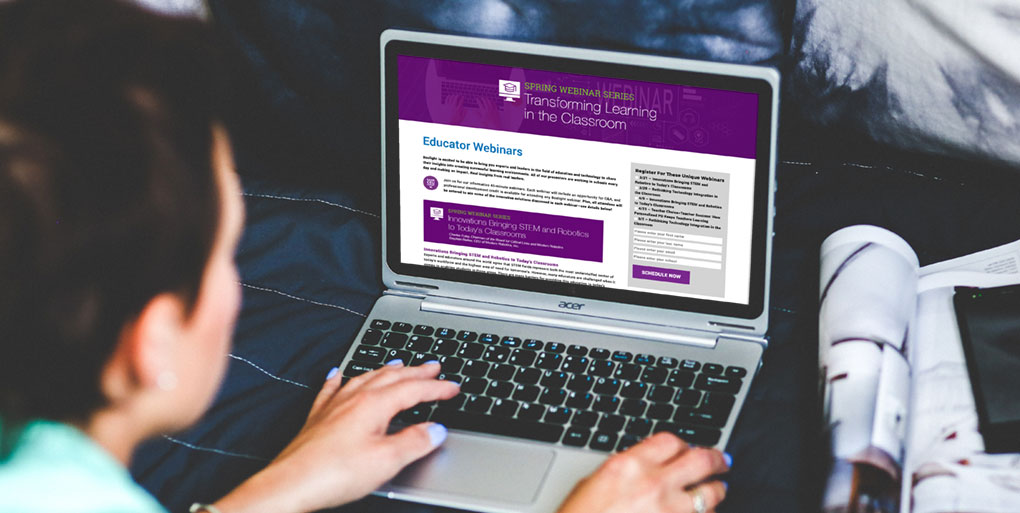
Boxlight is excited to announce the spring webinar series, Transforming Learning in the Classroom, featuring five webinars to help you improve upon important professional development and STEM integration in your school. The presenters are all experts and leaders in education and technology, and they are ready to share their insights into creating successful learning environments.
The series will begin on March 21, 2019 at 4:30 pm ET with Innovations Bringing STEM and Robotics to Today’s Classrooms. The experts hosting each webinar have used and loved each of the innovative solutions discussed in the webinars to engage students and promote STEM in the classroom. The webinars were developed to help educators of all types acquire useful knowledge to help bring their classroom to greater technology-driven heights.
Topics: webinar, Administrator Resources, tips for teachers
Twitter can be a great professional learning tool for teachers, but some teachers might be hesitant to get started. The root of this hesitancy can come from a variety of sources. Social media may not have a positive image in some teachers’ minds. The technology part can be intimidating, as well as the lack of knowledge about the tools themselves.
In hopes of encouraging teachers to get started—and possibly ease some of those fears—I have created a set of steps to get started with Twitter that are specific to the field of education.
Topics: Educational Apps, tips for teachers
In all the conversations that surround student engagement and learning, the focus almost always leans toward student activities and away from teacher-led instruction. These activities are very important to learning. As I often tell my teachers, “Whoever is doing the most work is doing the most learning.” Most of the time, we want the students doing the work. But as leaders and teachers, we can’t focus solely on what the students are doing—we have to also consider what the teacher is doing.
Topics: Education Technology, Whole-Class
Top Books for Educators
This is the perfect time of year to curl up with a good book! For educators, it’s especially important to read up on teaching trends, classroom innovations, and both the history and future of education. After all, the more we know about these important topics, the more beneficial it will be for our students.
Here are our picks for the top 20 books educators won’t want to miss:
Topics: education industry, tips for teachers
March 2nd Is Read Across America Day: Learn Why Every School Should Participate
I started my career teaching high school English. If you’d asked me back then about promoting Read Across America (RAA) Day, I would have thought you were crazy. Why would we celebrate Dr. Seuss’s birthday at the high school level when we could be focusing on Shakespeare, Thoreau, or Steinbeck? I’ve learned a lot over the years, and I know this to be true: Dr. Seuss never goes out of style. These books are fun, clever, and nostalgic—they turn children into readers and teach life lessons. They honor reading and show us how to be good citizens and friends. As an educator, parent, and lover of books, I urge teachers at all levels to plan a Read Across America celebration. Here are some reasons why:
Topics: tips for teachers